


By John Olson

Wednesday, November 15, 1989
North Kitsap Herald
Permission pending
As the North Kitsap day begins, we lumber off to Seattle ferries, submarine bases and shipyards, or arrive at hundreds of other work places to spend obligatory hours.
It's work. Unquestioned work. Eight hours per day, 40 hours per week, 50 odd weeks per year.
Now a retired wildlife biologist-turned-author living in Poulsbo is questioning work's very nature.
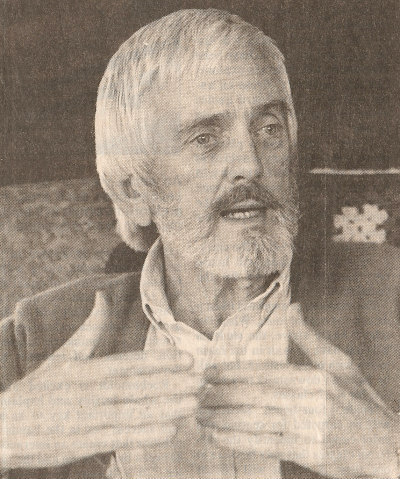
The rat race is over for Alan Courtright. The man of species studies and animal migrations has become a man of letters, and he has written a book to prove it.
Courtight recently self-published a quote-filled paperback called: The 6/12 Plan: Reslicing the Work Pie.
The 168-page, nine-chapter book, which advocates a six-hour personal workday and a 12-hour business day, probably won't win favor in corporate board rooms.
Courtright wrote the book to create jobs after contemplating the plight of Seattle's unemployed and homeless.
"Basically that's it," Courtright said, "but underlying it is the idea that everything has gotten too speeded up somehow."
Courtright is a Muskegon, Mich., native with wildlife management degrees from Utah State University and the University of Alaska. He settled in Poulsbo after time in Utah, Alaska, Guam, Spokane and Seattle.
Through all his working life, Courtright contemplated this beast we call work.
After running a plant nursery in Spokane for 12 years, Courtright sold the business and moved to Seattle where his wife worked on advanced degrees.
"I'd go to Pike Place early in the morning and see the people sleeping on the sidewalk," he said. "That started grabbing me. This is pretty damn awful for a helluva lot of people.
Courtright contrasted that scene with "self-important people coming out at 10 a.m. for coffee, and acting like the thing they were doing was the most important damned thing in the world."
In early 1986 he began writing notes and ideas, ending up with two feet of 3x5 notecards before realizing he needed a computer.
To Courtright the six-hour workday means changing American lifestyles.
"If we went to something like this, maybe things would slow down a bit," he said. "(We could) take it easy and get off the idea that faster and faster is the only way to go."
Courtright likens the working world to a whirlpool - exciting on the edges, but as you get closer to the center you find "you're going down the tube. It seems the whole country is going to that situation. The success track has to be no longer seen as the important track.
Courtright said his idea of quality of life is opposed to "so many people thinking it means lots of money, a new car, a big house. I'm hoping my book will be like one of many pieces of buckshot from a new shotgun that will get us moving on slowing down and enjoying life."
The benefits of a six-hour work day are many, Courtright claims. He says morning people can work from 7 a.m. to 1 p.m. and "then go home, make furniture, help (their) neighbor build a house, or a jillion things."
Courtright advises a night person can, "get up, mess around, eat a leisurely breakfast and at 1 or 2 p.m., go to work."
Other benefits include:
When asked if a six-hour workday would affect our economic competition with Japan, Courtright stood by his theory.
"I've read lately, that the Japanese are really not as underlyingly happy as most people assume," he said. "The assumption is that they love to work. Ask a few Japanese wives. Here is this middle echelon, white-collar, Japanese engineer, doing two hours of commuting. When he gets done work [sic], he doesn't want to go home because there isn't anything to do there.
Courtright contends the Japanese workforce will begin to examine their nationalistic tendency to work, work, work.
"Pretty soon," Courtright said, "if they've got any brains at all, they are going to say 'What about me? I'm not enjoying this anymore.' The Japanese are an intelligent people. At some point there are going to be some who stop and think about what it all means.
Courtright most admires people who have "stopped short of the summit, because they stopped to think and look around."
In that category he places former Washington Governor and Senator Dan Evans.
"God, I admire that man," Courtright said. "I wish there were some way he could be talked into running for President. He is a thinking man. He never, EVER, as far as I could tell, operated strictly on the basis of this is going to be good for my career. This is going to get me reelected."
Courtright realizes his book, which is available in area independent bookstores, will be controversial.
"If it does nothing else," he said, "I hope it gets discussions going, anywhere. Maybe the 6/12 Plan is not the answer. I see so many people who are doing things they don't want to do anymore. (They) find it's not what they want after all because it's competition, competition, competition."