


4 February 1982
Cheney Free Press, Cheney Washington
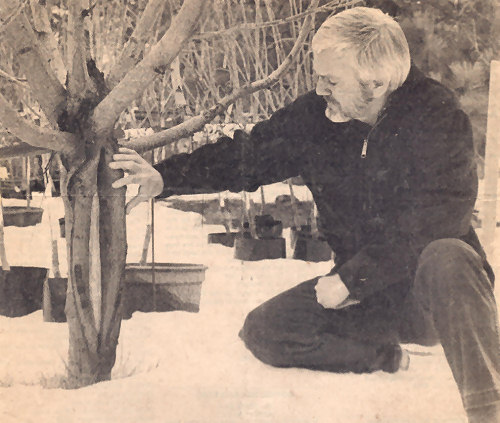
Although the coldest part of the winter may be past, the most damaging period for plants may still be ahead of us, according to Alan Courtright, owner of The Country Garden Nursery near Cheney.
"We had 20 degrees below one morning in December," Courtright said "and that will have hurt or killed quite a few plants, especially those planted within the last year or two. Weather patters common in February, though, can cause as much damage or more unless prevention measures are taken," he added.
It's not uncommon to have near-zero nights in February followed by bright sunny days, and rapid temperature changes, said the nurseryman, can cause more damage than "just plain cold."
Often termed "Southwest damage" because it usually appears on that side of the plat, the problem is caused by too-rapid freezing or thawing when the air is very cold, alternating with the sun, hitting dark tree bark and magnified by reflection from snow, heats the bark to as much as 50 degrees and sometimes even more. When the sun goes down or a shadow hits the plant, the cells freeze before they can eliminate excess water and burst.
"The way to prevent such damage," Courtright said, "is to put something on the trunk to keep it from heating up so much and to keep it from freezing so rapidly when the sun goes down." The simplest procedure is to paint the lower trunk with white interior latex paint (not exterior latex or oil paint), but wrapping the trunk with strips of white cloth, aluminum foil, loose burlap, or tree wrap is probably even better, he said.
Most "Southwest damage" occurs in the six inches or so above the snow, the nurseryman indicated, and that's the part most in need of protection. Some trees, though, can be damaged right up to the first branches if conditions are right. And regardless of how extensive the damage is, he said, it often doesn't become apparent for a year or more, when the bark begins to split.
"That's when people call me and ask me what can be done, but by then it's too late. There's no treatment; prevention is the key.