

By Sanka Knox
May 26, 1956
New York Times
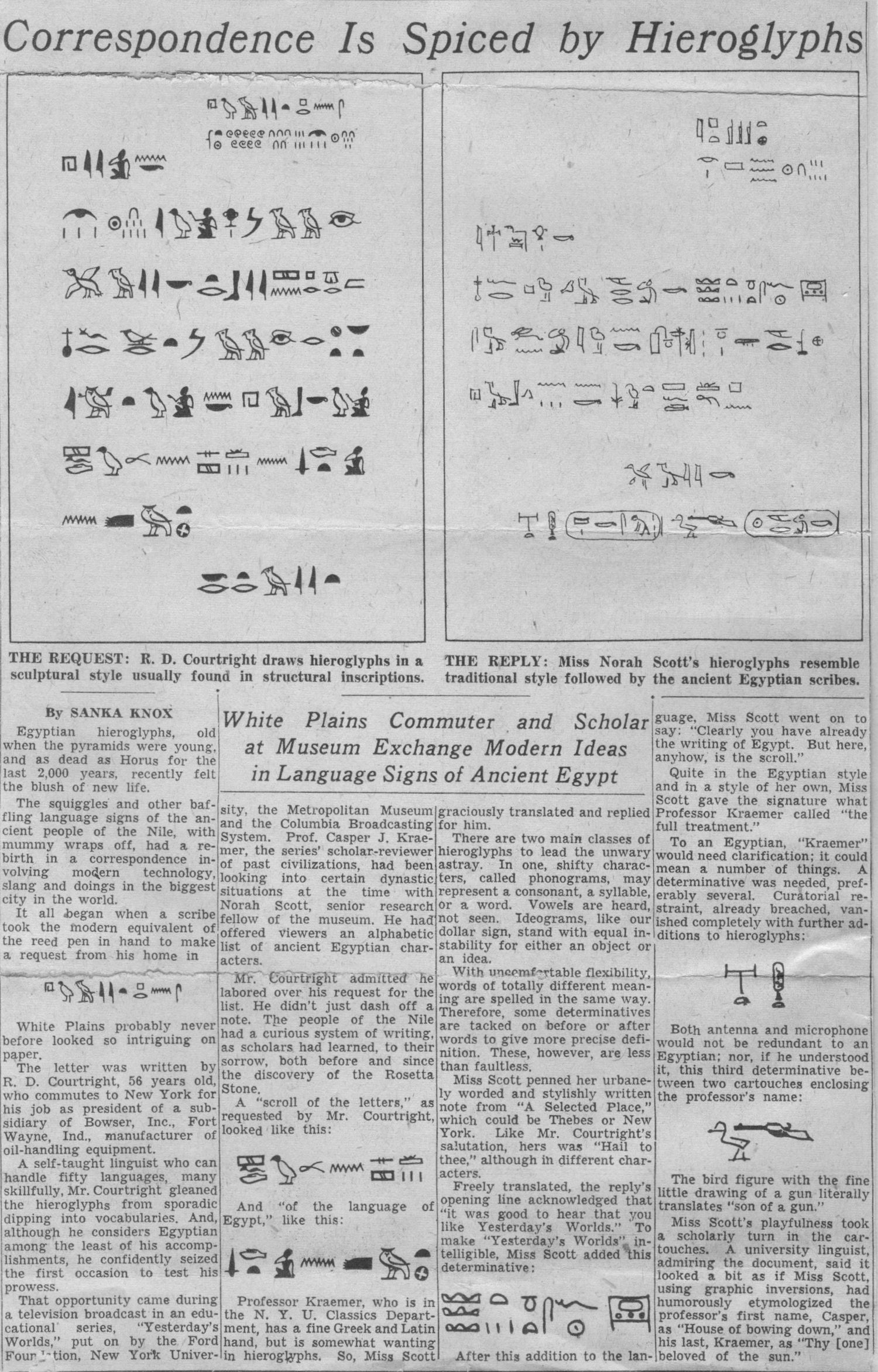
Egyptian hieroglyphs, old when the pyramids were young, and as dead as Horus for the last 2,000 years, recently felt the blush of new life.
The squiggles and other baffling language signs of the ancient people of the Nile, with mummy wraps off, had a rebirth in a correspondence involving modern technology, slang and doings in the biggest city in the world.
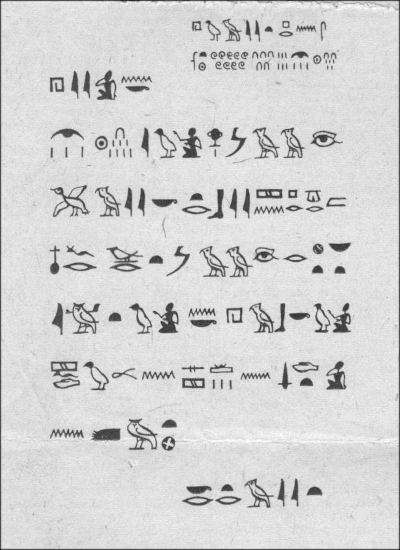
It all began when a scribe took the modern equivalent of the reed pen in hand to make a request from his home in
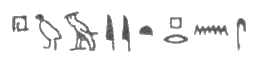
White Plains probably never before looked so intriguing on paper.
The letter was written by R. D. Courtright, 56 years old, who commutes to New York for his job as president of a subsidiary of Bowser, Inc., Fort Wayne, Ind., manufacturer of oil-handling equipment.
A self-taught linguist who can handle fifty languages, many skillfully, Mr. Courtright gleaned the hieroglyphs from sporadic dipping into vacabularies. And, although he considers Egyptian amoung the least of his accomplishments, he confidently seized the first occasion to test his prowess.
That opportunity came during a television boradcast in an educational series, "Yesterday's Worlds," put on by the Ford Foundation, New York University, the Metropolitan Museum and the Columbia Broadcasting System. Prof. Casper J. Kraemer, the series' scholar-reviewer of past civilizations, had been looking into certain dynastic situations at the time with Norah Scott, senior research fellow of the museum. He had offered viewers an aphabetic list of ancient Egyptian characters.
Mr. Courtright admitted he labored over his request for the list. He didn't just dash off a note. The people of the Nile had a curious system of writing, as scholars had learned, to their sorrow, both before and since the discovery of the Rosetta Stone.
A "scroll of the letters," as requested by Mr. Courtright, looked like this:

And "of the language of Egypt," like this:
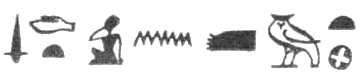
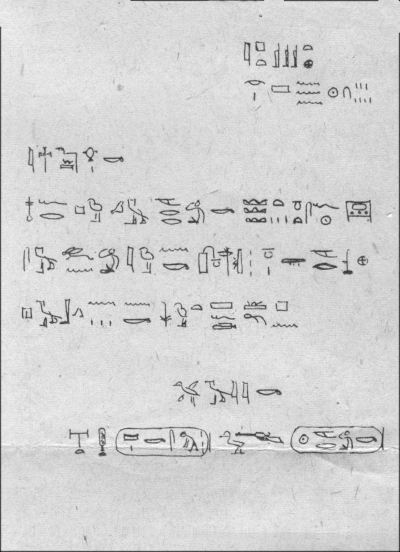
Professor Kraemer, who is in the N.Y.U. Classics Department, has a fine Greek and Latin hand, but is somewhat wanting in hieroglyphs. So, Miss Scott graciously translated and replied for him.
There are two main classes of hieroglyphs to lead the unwary astray. In one, shifty characters, called phonograms, may represent a consonant, a syllable, or a word. Vowels are heard, not seen. Ideograms, like our dollar sign, stand with equal instability for either and object or an idea.
With uncomfortable flexibility, words of totally different meaning are spelled in the same way. Therefore, some determinatives are tacked on before or after words to give more precise definition. These, however, are less than faultless.
Miss Scott penned her urbanely worded and stylishly written note from "A Selected Place," which could be Thebes or New York. Like Mr. Courtright's salutation, hers was "Hail to thee," although in different characters.
Freshly translated, the reply's opening line acknowledged that "it was good to hear that your like Yesterday's Worlds." To Make "Yesterday's Worlds" intelligible, Miss Scott added this determinative:

After this addition to the language, Miss Scott went on to say: "Clearly your have already the writing of Egypt. But here, anyhow, is the scroll."
Quite in the Egyptians style and in a style of her own, Miss Scott gave the signature what Professor Kraemer called "the full treatment."
To an Egyptian, "Kraemer" would need clarification; it could mean a number of things. A determinative was needed, preferably several. Curatorial restraint, already breached, vanished completely with further additions to hieroglyphs:

Both antenna and microphone would not be redundant to an Egyptian; nor, if he understood it, this third determinative between two cartouches enclosing the professor's name:

The bird figure with the fine little drawing of a gun literally translates "son of a gun."
Miss Scott's playfulness took a scholarly turn in the cartouches. A university inguist, admiring the document, said it looked a bit as if Miss Scott, using graphic inversions, had humorously etymologized the professor's first name, Casper, as "House of bowing down," and his last, Kraemer, as "Thy [one] beloved of the sun."
Click here for clipping of original article.